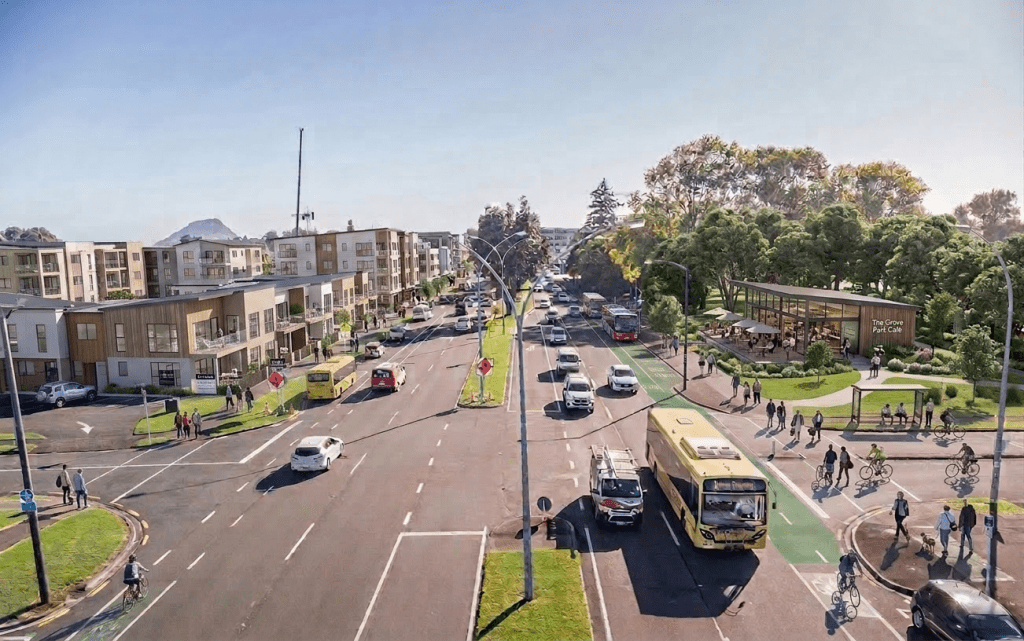
Comparing 12,000 Homes at Te Tumu with 12,000 Homes Along the City Centre–Cameron Road Spine
Tauranga faces a significant housing challenge over the coming decades. The Western Bay Regional Deal proposes substantial investment in infrastructure to unlock approximately 12,000 homes within the Te Tumu growth area.
What if the same housing outcome—12,000 homes—was delivered primarily within the existing urban area along the City Centre–Cameron Road corridor?
The purpose is not to suggest that growth should stop. The purpose is to compare two different ways of accommodating the same population and to understand the economic, infrastructure, demographic and resilience implications of each approach.


The Changing Nature of Housing Demand
The housing needs of Tauranga in 2050 will differ significantly from those of previous generations.
Several long-term trends are already emerging:
An Ageing Population
The Bay of Plenty has one of New Zealand’s oldest age profiles and is expected to continue ageing over coming decades.
Many future residents will increasingly seek:
- Smaller homes
- Low-maintenance living
- Lift-served apartments
- Accessible design
- Proximity to healthcare
- Walkable neighbourhoods
- Reduced reliance on driving
Smaller Households
Average household sizes continue to decline due to:
- More people living alone
- Longer life expectancy
- Delayed family formation
- Changing lifestyle preferences
A growing proportion of future households will not require a detached home on a suburban section.
Workforce Attraction
Tauranga must also attract:
- Healthcare workers
- Teachers
- Tradespeople
- Young professionals
- Students
These groups increasingly seek:
- Affordable housing
- Smaller homes
- Reduced commuting costs
- Proximity to employment and services
Why the City Centre–Cameron Road Spine?
The City Centre–Cameron Road corridor already contains many of the region’s most important destinations:
- Tauranga Hospital
- Tauranga City Centre
- University facilities
- Government services
- Secondary schools
- Employment centres
- Existing public transport corridors
- Future rapid transit opportunities
Unlike greenfield expansion, much of the infrastructure, employment and social infrastructure already exists.
The corridor also provides opportunities for:
- Apartment development
- Terraced housing
- Retirement living
- Build-to-rent housing
- Mixed-use development
- Healthcare-related accommodation
Growth Comparison
Scenario A – Te Tumu
12,000 homes delivered through greenfield urban expansion.
Scenario B – City Centre–Cameron Road Spine
12,000 homes delivered through a coordinated programme of:
- Apartments
- Terraces
- Mixed-use development
- Retirement living
- Build-to-rent projects
- Urban regeneration around centres and public transport corridors
Both scenarios deliver approximately the same number of homes.
Comparative Assessment
| Measure | Te Tumu Growth Model | City Centre–Cameron Road Model |
| Homes delivered | 12,000 | 12,000 |
| Estimated population | 30,000–33,000 people | 24,000–30,000 people |
| Primary housing types | Detached housing, duplexes, terraces | Apartments, terraces, mixed-use, retirement living |
| Match with ageing population trends | Moderate | High |
| Match with smaller household trends | Moderate | High |
| Access to Tauranga Hospital | Lower | High |
| Access to employment | Lower | High |
| Access to public transport | Moderate | High |
| Walking and cycling opportunities | Moderate | High |
| Car dependency | Higher | Lower |
| Support for city centre revitalisation | Low | High |
| Support for existing public investment | Moderate | High |
| Infrastructure efficiency | Lower | Higher |
| Housing diversity | Moderate | High |
| Long-term emissions profile | Higher | Lower |
| Climate resilience | Moderate | Higher |
| Delivery certainty | Higher | Lower |
| Key challenge | Infrastructure cost | Development feasibility |
Infrastructure Comparison
Previous Tauranga investigations and international research indicate that intensification can significantly reduce infrastructure costs compared with greenfield expansion.
Indicative Savings
| Measure | Value |
| Conservative saving per dwelling | $25,000 |
| Moderate saving per dwelling | $35,000–45,000 |
| High benchmark saving per dwelling | Up to $80,000 |
| Conservative saving across 12,000 homes | $300 million |
| Moderate saving across 12,000 homes | $420–540 million |
| High benchmark saving across 12,000 homes | Up to $960 million |
The most defensible range is considered to be:
$300–540 million of avoided infrastructure expenditure.
Climate and Resilience Considerations
Te Tumu is a significant coastal growth area.
While it can be engineered and planned appropriately, long-term growth decisions increasingly need to consider:
- Sea level rise
- Coastal inundation
- Coastal erosion
- Flood risk
- Long-term infrastructure adaptation costs
The City Centre–Cameron Road spine is not risk-free and requires ongoing stormwater investment and climate adaptation.
However, concentrating growth within existing urban areas generally reduces exposure to future coastal growth risks and allows greater use of existing infrastructure and services.
Economic Outcomes
A city spine growth model would:
- Increase support for city centre businesses
- Increase utilisation of existing public investment
- Improve public transport viability
- Support future rail and rapid transit opportunities
- Reduce infrastructure duplication
- Strengthen the hospital and education precincts
- Increase rates revenue from existing urban areas
A compact urban population also generates significantly more activity within existing centres, improving the viability of local retail, hospitality and services.
Enabling Delivery on the Te Papa Peninsula
A compact city growth model cannot rely on planning provisions alone. If Tauranga wishes to accommodate a significant share of future growth within the existing urban area, a deliberate delivery programme would be required to ensure housing is actually built.
The infrastructure savings associated with delivering 12,000 homes within the City Centre–Cameron Road corridor, estimated at approximately $300–540 million, create an opportunity to invest directly in the conditions needed for urban development to occur.
Rather than directing all growth-related investment toward expanding the urban edge, a portion of these savings could be reinvested into the Te Papa peninsula through a coordinated programme of urban regeneration and housing delivery. This could include:
A programme of this nature would recognise that successful urban intensification is not solely a housing exercise. It is a place-making exercise. Housing delivery becomes significantly more achievable when accompanied by high-quality public spaces, reliable public transport, attractive streets, accessible services and a strong sense of community.
Reinvesting in Existing Communities and Creating a Lasting Legacy
A significant advantage of a compact city growth model is that investment can be staged over time and directed toward improvements that benefit both future and existing residents.
Unlike greenfield development, where a large proportion of infrastructure expenditure is required upfront to service new growth areas, investment within the Te Papa peninsula can be progressively delivered as development occurs. This reduces financial risk while allowing infrastructure delivery to respond to actual growth demand.
Importantly, many of these investments provide immediate benefits to the approximately 25,000–30,000 residents already living within the Te Papa peninsula, regardless of whether additional housing is delivered.
Potential investments could include:
- New neighbourhood parks and public open spaces.
- Streetscape upgrades and urban greening.
- Walking and cycling connections.
- Water-sensitive urban design and stormwater improvements.
- Improved public transport and rapid transit infrastructure.
- Community facilities and recreational amenities.
- Public realm improvements around local centres and schools.
- Development incentives to encourage housing delivery.
These investments would not only support future growth but would also improve the quality of life, health, mobility and resilience of existing communities.
By comparison, a large proportion of investment in greenfield areas is directed toward infrastructure required solely because new development is occurring. New roads, pipes, community facilities and transport connections primarily serve future residents rather than existing communities.
This creates a fundamentally different value proposition.
Under a greenfield model, public investment is largely focused on enabling expansion.
Under a compact city model, public investment simultaneously:
- Enables growth,
- Improves existing neighbourhoods,
- Supports local businesses,
- Strengthens public transport,
- Enhances environmental outcomes, and
- Increases the return on previous public investment.
The result is that every dollar invested has the potential to deliver benefits to both current and future residents, creating a compounding return that extends well beyond housing delivery alone.
Perhaps most importantly, the two approaches leave very different legacies.
A compact city approach creates a legacy of improved parks, greener streets, better public transport, stronger neighbourhood centres, safer walking and cycling connections, healthier waterways and a more vibrant city for future generations. These investments continue to serve existing residents immediately while also supporting future growth.
At the same time, reducing the need for large-scale urban expansion creates an opportunity to consider a different future for Te Tumu. Rather than becoming another major urban growth area, Te Tumu could become one of the Bay of Plenty’s most significant regional open spaces—a place where natural systems, wetlands, biodiversity and coastal landscapes are protected and enhanced for future generations.
Such a legacy would provide benefits that extend well beyond housing. It would create opportunities for recreation, ecological restoration, education, cultural expression and public enjoyment while preserving a significant natural landscape for the wider region.
Viewed through this lens, the question is no longer simply where 12,000 homes should be located.
It becomes a broader question about legacy:
Should public investment be used primarily to expand the urban footprint, or could the same investment create a more compact, connected and resilient city while leaving future generations with both a stronger urban environment and a protected natural landscape at Te Tumu?


Leave a comment